April 24, 2026
April 24, 2026
The Zero-Markup AI Manifesto: Why Credit Taxes Are Over
Every AI tool taxes you through credits. Here's the real math on what models cost, what platforms charge, and why the markup era is ending.
Every AI tool taxes you through credits. Here's the real math on what models cost, what platforms charge, and why the markup era is ending.
Every creative tool built on top of AI models either passes the real per-generation cost straight through to you, or marks it up, repackages it as credits, and hopes you never do the division. Most platforms do the second thing. That tax is about to stop working.
Every creative tool built on top of AI models does one of two things with your money.
It either passes the real per-generation cost straight through to you, or it marks it up, repackages it as "credits," and hopes you never do the division.
Almost every platform you've used does the second thing. That's the tax. This post is about why that tax exists, what it actually costs you, and why it's about to stop working as a pricing model.
The 40-second version
AI image and video models have public, per-generation prices. Your platform buys them at those prices. Then most platforms resell access at 2 to 4 times that cost, wrap it in a credit system that makes the math hard to check, and call it a subscription. We think that model is quietly collapsing, because creators have started doing the division. Kubflow is priced at cost. No markup on model inference. You pay what the model costs, and we charge a flat fee for the canvas that runs them.
What a "credit" actually is
A credit is a coupon your platform sells you. It has no fixed meaning. The same "credit" can buy you six seconds of video on one plan and one second on another. It can get cheaper when you upgrade and more expensive when you run out. It can also expire.
Runway is the cleanest example to use because its pricing is public and well documented. As of February 2026, Runway's Standard plan is listed at $12 per month (annual) or $15 per month (monthly), which gets you 625 credits (Runway pricing, via SaaS CRM Review). Gen-4 Turbo costs 5 credits per second of video. Gen-4 standard is 12 credits per second.
So 625 credits is about 125 seconds of Gen-4 Turbo per month, or roughly 52 seconds of Gen-4 standard (Max Productive). That's two minutes of finished footage. At the Standard tier. For $15 a month.
Now compare that to what the underlying model actually costs a platform to run. Seedance 2.0 Fast, through third-party API providers, is listed at around $0.022 per second (Atlas Cloud, Cutout.pro). A 10-second clip at that rate is 22 cents.
Look at how those numbers diverge. The credit system lets a platform charge you subscription-level money for API-level compute and never show you the delta.
Why it happens
Three reasons, in order of honesty.
Reason one: someone has to pay for the infrastructure around the model. Storage, UI, collaboration, support, queue management, brand safety. Real costs. We get it. We pay for ours too.
Reason two: opacity is profitable. If you know a ten-second Seedance 2.0 clip costs 22 cents to generate, you will not pay $15 for the privilege of generating twelve of them. If you only know it costs "100 credits," you might. Credits are not a billing system. They are a friction layer on top of a billing system.
Reason three: it used to be the only option. When models were expensive, unpredictable, and changing every week, wrapping them in credits was a way to protect platforms from cost swings. That era is ending. Models are cheaper, prices are stabilizing, and most consumer-facing models now publish per-second or per-image rates. The excuse has run out.
What the markup actually looks like
Let's do the comparison with real, dated, linked numbers. Say you want to produce 60 seconds of finished Seedance 2.0 video this month. Here's what it costs at different access points.
Access point | Effective cost for 60 seconds | Source |
|---|---|---|
ByteDance official API (Volcengine) | about $8.40 (at ~$0.14/sec) | |
Third-party APIs (Fast tier) | about $1.32 (at ~$0.022/sec) | |
Typical consumer platform with credit markup | $15 to $30 per month minimum, with caps | varies |
Now do the same exercise for a month of Runway Gen-4 Turbo. On the Standard plan at $15 per month (monthly billing), 625 credits will get you 125 seconds of Gen-4 Turbo (Max Productive, DEV Community). That's $0.12 per second of finished video, as a baseline. And that's on Gen-4 Turbo, which is the cheaper model in the Gen-4 family.
Per-second cost is the number that matters. Every other pricing format is there to obscure it.
The thing we can't get over
Creators and agencies who use these tools professionally are running into the same ceiling every month. They buy a plan. They run out of credits halfway through a project. They upgrade. They run out again. They top up. They forget a generation was queued and eat the credits on a misfired prompt. They cancel.
This is not a power-user complaint. This is the modal experience of paying for AI tools in 2026. Go into any subreddit that talks about AI video and count the "I ran out of credits" posts. That's your signal.
The credit model works for the platform. It does not work for the person opening the platform.
The Kubflow position
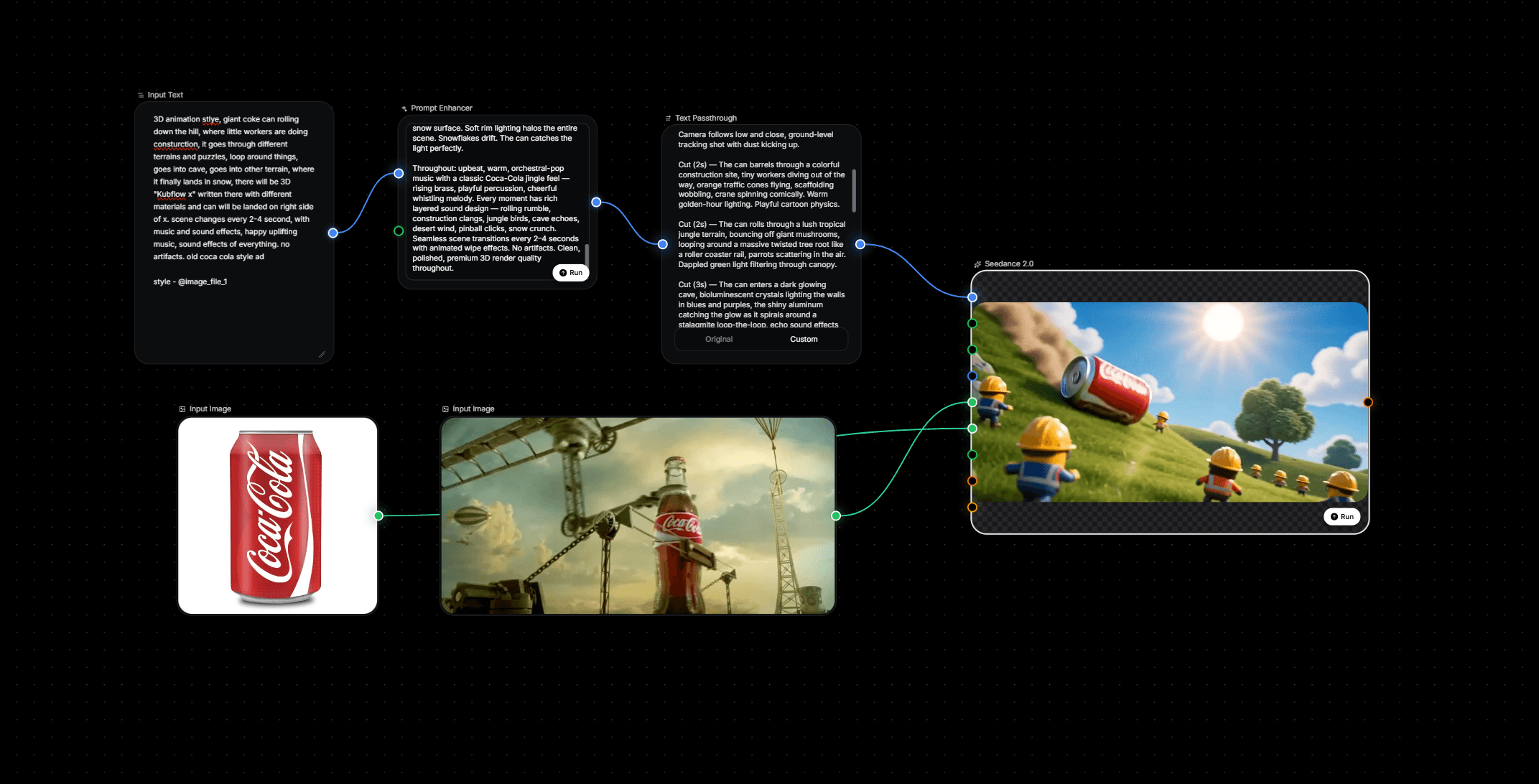
We built Kubflow as a node-based canvas where you chain models together: image model to video model to voice model to upscaler, or whatever shape your workflow needs. That's the product.
The pricing decision is separate, and it's this: we do not mark up model inference.
When you run a Seedance 2.0 generation inside Kubflow, you pay what Seedance 2.0 costs us, at wholesale. When you run Veo 3.1, you pay what Veo 3.1 costs us. Same for Nano Banana 2, Flux 2 Pro, Kling 3.0, ElevenLabs, Topaz, all of them. You can see the per-second or per-image rate on every node before you run it. No credit conversion layer. No private exchange rate.
We charge a flat platform fee for the canvas, the collaboration, the templates, and the storage. That fee pays for Kubflow. The models pay for themselves, at cost.
The net effect, on the workflows we've tested against published competitor rates, is that a typical 60-second ad built on Kubflow runs between 2x and 4x cheaper than the same workflow on Runway, Picsart, or a typical consumer credit-based platform. Your mileage will vary depending on model choice, resolution, and duration, which is why we show the running cost on every node as you build.
What this changes
Three things, in practice.
You can actually test. When each generation costs what it costs, running 40 variations of a hook is a line item, not a panic attack. This is the single biggest quality-of-life shift for anyone doing performance ad work.
You can budget a project. A 90-second piece, three versions, two languages, final-quality model on the hero shots and fast model on the B-roll, is a number you can write down before you start. Not a credit guess. An actual dollar figure.
You can change models without getting punished. Most credit systems implicitly tax you for using the newest or highest-quality model. Ours doesn't. You pick the model that fits the shot, and you pay its real rate.
The math we wish someone had shown us sooner
If you take nothing else from this post, take this: the next time a platform quotes you a price, convert it to dollars per second or dollars per image using that platform's own published credit conversion. Then find the underlying model's API price. Then divide one by the other.
The number you get is the markup. If it's under 1.2x, the platform is running close to cost. If it's between 1.5x and 2x, that's the normal range. If it's 3x or more, you're funding someone else's margin on compute that is already commoditized.
We're not saying every platform needs to be at 1x. Building a good canvas is real work, and real work should be paid for. We are saying the industry norm of hiding the markup inside credit conversions is ending, because the math is now trivial to do and the per-generation prices are now public.
The tax is over. We just decided to be the first ones to say it out loud.
Ready to see what a zero-markup canvas looks like? Start a free Kubflow workspace and watch the per-generation cost tick up on every node as you build. No credits. No markup. No math homework.
Have a favorite model we should add next? Tell us.
Related reading
How do AI credits actually work (and why you're probably overpaying)
Top 10 AI video generators in 2026, ranked by cost per second
Kubflow vs Runway: the cost comparison, with sources
A quick note on the numbers in this post. Every competitor price we quote is linked to a dated, public source. AI model pricing changes monthly. If you're reading this more than a quarter after the "last updated" date at the top, treat the specific numbers as directional and check the linked sources for current rates. The argument holds regardless of whether Runway's Standard plan costs $12 or $18 next month, which is sort of the point.


Every creative tool built on top of AI models either passes the real per-generation cost straight through to you, or marks it up, repackages it as credits, and hopes you never do the division. Most platforms do the second thing. That tax is about to stop working.
Every creative tool built on top of AI models does one of two things with your money.
It either passes the real per-generation cost straight through to you, or it marks it up, repackages it as "credits," and hopes you never do the division.
Almost every platform you've used does the second thing. That's the tax. This post is about why that tax exists, what it actually costs you, and why it's about to stop working as a pricing model.
The 40-second version
AI image and video models have public, per-generation prices. Your platform buys them at those prices. Then most platforms resell access at 2 to 4 times that cost, wrap it in a credit system that makes the math hard to check, and call it a subscription. We think that model is quietly collapsing, because creators have started doing the division. Kubflow is priced at cost. No markup on model inference. You pay what the model costs, and we charge a flat fee for the canvas that runs them.
What a "credit" actually is
A credit is a coupon your platform sells you. It has no fixed meaning. The same "credit" can buy you six seconds of video on one plan and one second on another. It can get cheaper when you upgrade and more expensive when you run out. It can also expire.
Runway is the cleanest example to use because its pricing is public and well documented. As of February 2026, Runway's Standard plan is listed at $12 per month (annual) or $15 per month (monthly), which gets you 625 credits (Runway pricing, via SaaS CRM Review). Gen-4 Turbo costs 5 credits per second of video. Gen-4 standard is 12 credits per second.
So 625 credits is about 125 seconds of Gen-4 Turbo per month, or roughly 52 seconds of Gen-4 standard (Max Productive). That's two minutes of finished footage. At the Standard tier. For $15 a month.
Now compare that to what the underlying model actually costs a platform to run. Seedance 2.0 Fast, through third-party API providers, is listed at around $0.022 per second (Atlas Cloud, Cutout.pro). A 10-second clip at that rate is 22 cents.
Look at how those numbers diverge. The credit system lets a platform charge you subscription-level money for API-level compute and never show you the delta.
Why it happens
Three reasons, in order of honesty.
Reason one: someone has to pay for the infrastructure around the model. Storage, UI, collaboration, support, queue management, brand safety. Real costs. We get it. We pay for ours too.
Reason two: opacity is profitable. If you know a ten-second Seedance 2.0 clip costs 22 cents to generate, you will not pay $15 for the privilege of generating twelve of them. If you only know it costs "100 credits," you might. Credits are not a billing system. They are a friction layer on top of a billing system.
Reason three: it used to be the only option. When models were expensive, unpredictable, and changing every week, wrapping them in credits was a way to protect platforms from cost swings. That era is ending. Models are cheaper, prices are stabilizing, and most consumer-facing models now publish per-second or per-image rates. The excuse has run out.
What the markup actually looks like
Let's do the comparison with real, dated, linked numbers. Say you want to produce 60 seconds of finished Seedance 2.0 video this month. Here's what it costs at different access points.
Access point | Effective cost for 60 seconds | Source |
|---|---|---|
ByteDance official API (Volcengine) | about $8.40 (at ~$0.14/sec) | |
Third-party APIs (Fast tier) | about $1.32 (at ~$0.022/sec) | |
Typical consumer platform with credit markup | $15 to $30 per month minimum, with caps | varies |
Now do the same exercise for a month of Runway Gen-4 Turbo. On the Standard plan at $15 per month (monthly billing), 625 credits will get you 125 seconds of Gen-4 Turbo (Max Productive, DEV Community). That's $0.12 per second of finished video, as a baseline. And that's on Gen-4 Turbo, which is the cheaper model in the Gen-4 family.
Per-second cost is the number that matters. Every other pricing format is there to obscure it.
The thing we can't get over
Creators and agencies who use these tools professionally are running into the same ceiling every month. They buy a plan. They run out of credits halfway through a project. They upgrade. They run out again. They top up. They forget a generation was queued and eat the credits on a misfired prompt. They cancel.
This is not a power-user complaint. This is the modal experience of paying for AI tools in 2026. Go into any subreddit that talks about AI video and count the "I ran out of credits" posts. That's your signal.
The credit model works for the platform. It does not work for the person opening the platform.
The Kubflow position
We built Kubflow as a node-based canvas where you chain models together: image model to video model to voice model to upscaler, or whatever shape your workflow needs. That's the product.
The pricing decision is separate, and it's this: we do not mark up model inference.
When you run a Seedance 2.0 generation inside Kubflow, you pay what Seedance 2.0 costs us, at wholesale. When you run Veo 3.1, you pay what Veo 3.1 costs us. Same for Nano Banana 2, Flux 2 Pro, Kling 3.0, ElevenLabs, Topaz, all of them. You can see the per-second or per-image rate on every node before you run it. No credit conversion layer. No private exchange rate.
We charge a flat platform fee for the canvas, the collaboration, the templates, and the storage. That fee pays for Kubflow. The models pay for themselves, at cost.
The net effect, on the workflows we've tested against published competitor rates, is that a typical 60-second ad built on Kubflow runs between 2x and 4x cheaper than the same workflow on Runway, Picsart, or a typical consumer credit-based platform. Your mileage will vary depending on model choice, resolution, and duration, which is why we show the running cost on every node as you build.
What this changes
Three things, in practice.
You can actually test. When each generation costs what it costs, running 40 variations of a hook is a line item, not a panic attack. This is the single biggest quality-of-life shift for anyone doing performance ad work.
You can budget a project. A 90-second piece, three versions, two languages, final-quality model on the hero shots and fast model on the B-roll, is a number you can write down before you start. Not a credit guess. An actual dollar figure.
You can change models without getting punished. Most credit systems implicitly tax you for using the newest or highest-quality model. Ours doesn't. You pick the model that fits the shot, and you pay its real rate.
The math we wish someone had shown us sooner
If you take nothing else from this post, take this: the next time a platform quotes you a price, convert it to dollars per second or dollars per image using that platform's own published credit conversion. Then find the underlying model's API price. Then divide one by the other.
The number you get is the markup. If it's under 1.2x, the platform is running close to cost. If it's between 1.5x and 2x, that's the normal range. If it's 3x or more, you're funding someone else's margin on compute that is already commoditized.
We're not saying every platform needs to be at 1x. Building a good canvas is real work, and real work should be paid for. We are saying the industry norm of hiding the markup inside credit conversions is ending, because the math is now trivial to do and the per-generation prices are now public.
The tax is over. We just decided to be the first ones to say it out loud.
Ready to see what a zero-markup canvas looks like? Start a free Kubflow workspace and watch the per-generation cost tick up on every node as you build. No credits. No markup. No math homework.
Have a favorite model we should add next? Tell us.
Related reading
How do AI credits actually work (and why you're probably overpaying)
Top 10 AI video generators in 2026, ranked by cost per second
Kubflow vs Runway: the cost comparison, with sources
A quick note on the numbers in this post. Every competitor price we quote is linked to a dated, public source. AI model pricing changes monthly. If you're reading this more than a quarter after the "last updated" date at the top, treat the specific numbers as directional and check the linked sources for current rates. The argument holds regardless of whether Runway's Standard plan costs $12 or $18 next month, which is sort of the point.